Habits & Mindset
You Don’t Need Another Diet. You Need a System.
Diets run on rules that need daily attention. A system runs on defaults that hold in a busy month. Here are its six parts and the order to build them in.
 Jan B.Co-Founder and CTO of ZANE
- 5 min read
- 3 sources
In this article 8 sections
Key takeaways
- Discipline works in sprints. Eating is daily repetition over years.
- A 23-lab replication found no evidence that willpower drains like a battery. People with high self-control simply face fewer temptations.
- A nutrition system has six parts: eating window, breakfast template, protein with plants, default groceries and dinners, fallbacks and a sleep window.
- Build it one part at a time, starting with when you eat.
Most driven men have tried several diets: low carb, intermittent fasting, macro tracking, clean eating, keto. Each one worked for a while. Then work picked up, travel increased, stress rose and the structure fell apart.
If your eating collapses every busy month, look at the design before you question your discipline. Diets run on rules that need constant attention. A system runs on defaults that keep going in the background. Here’s the difference, and a blueprint for building one.
The discipline trap
Many men who struggle with food are highly disciplined everywhere else. They build companies, lead teams and manage money. So how can someone that structured still fail at eating?
Discipline works well in sprints: a deadline, a launch, a short push. Eating is daily repetition over years. If your approach depends on being “on,” there will be weeks when you’re “off.”
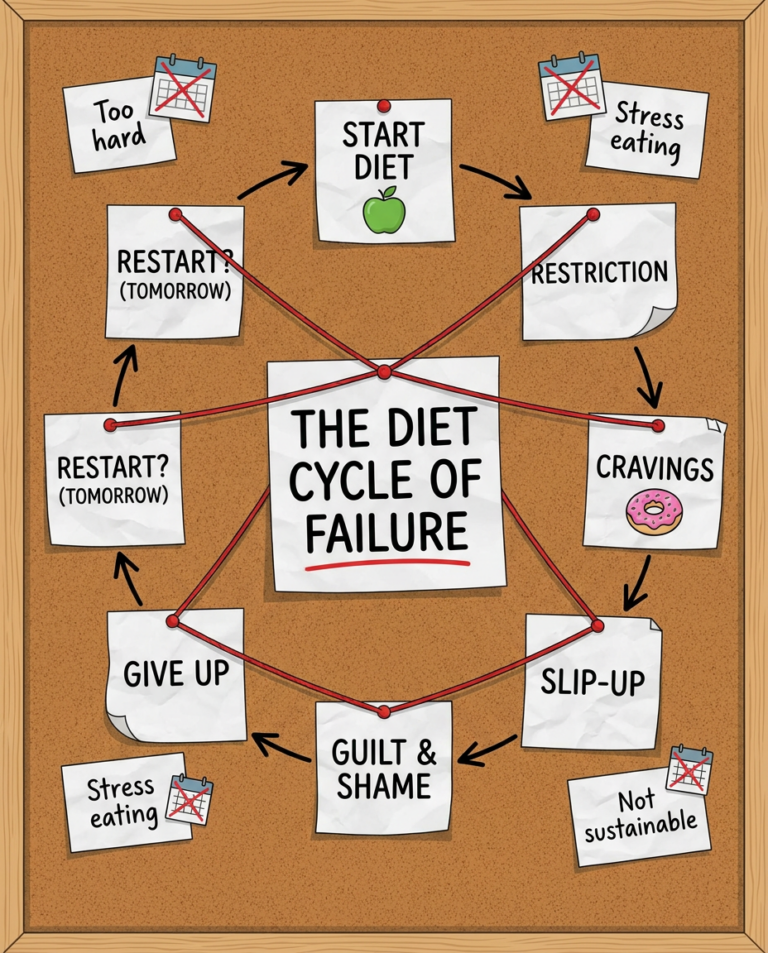
There’s an identity problem too. Men who see themselves as strong and capable take falling off a diet personally. So they double down with stricter rules, harder cuts and more control, which feeds the next crash. Why you can’t stick to a diet describes that cycle in detail.
Willpower isn’t a battery
A popular explanation says willpower is like a phone battery that drains with every decision until it’s empty by 9 p.m. The idea, known as ego depletion, was famous for years. Then 23 labs repeated the classic experiment with more than 2,000 participants, following the same preregistered protocol, and found an effect close to zero.
That doesn’t make willpower the right tool. Research on people with high self-control points somewhere else. In a study that checked in with people several times a day, those with high self-control reported running into fewer temptations to begin with. Other studies found that their good habits explained much of their success. They don’t resist more. They’ve arranged their lives so there’s less to resist, which is exactly what a system does.
Diet versus system
A diet tells you what to eat and, usually, what to cut out. It depends on high engagement: tracking, measuring and adjusting every day. That’s sustainable in short bursts, rarely for years alongside a job, a family and pressure.
A system sets up repeatable defaults that hold under stress. It narrows the number of decisions and makes the right choice the easy one. Two examples show the difference:
- Discipline is resisting the chips at 8 p.m. A system is not having chips in the house.
- Discipline is forcing yourself to cook after a long day. A system is having two or three default dinners you can make on autopilot.
You already run your work this way. You don’t rely on motivation to run operations, you build processes. Your eating can follow the same logic.
The six parts of a nutrition system
1. A consistent eating window. Set a time for your first meal and a time when the kitchen closes, for example first meal around 8 or 9 a.m. and nothing after 8 p.m. That puts a limit on random snacking and late-night grazing. It doesn’t need to be extreme fasting. Intermittent fasting for men covers stricter versions if you want them.
2. A breakfast template. Pick one or two breakfasts and repeat them: eggs with vegetables, Greek yogurt with fruit and oats, overnight oats with a scoop of protein. Put out what you need the night before if mornings are rushed.
3. Protein at every meal, with plants next to it. A palm of protein and a fist of vegetables, beans or fruit at each meal. You don’t need to count grams, just check that both are there. See how much protein men actually need and what fibermaxxing gets right.
4. A repeatable grocery list and default dinners. One list you reorder every week, two or three dinners you can cook without thinking, and a go-to snack in your bag or car, such as nuts or jerky.
5. Fallbacks for bad days. Decide now what you eat when the day falls apart: a rotisserie chicken with a bagged salad, Greek yogurt with protein powder, your standard order at the place near the office. How to eat healthy when you’re busy has more options.
6. A regular sleep window. A fixed bedtime and wake time, within reason. Sleep regulates hunger hormones and stress, and without it everything else gets harder. How sleep deprivation makes you fat explains why.
Notice what’s missing: no calorie math, no daily tracking, no extreme restriction.
Build it one part at a time
Don’t set up all six at once. That turns the system into another overhaul. A sensible order:
- Timing first. Decide when you eat and hold that boundary.
- Then what’s on the plate. Protein and plants at every meal, with repeatability over perfection.
- Then your environment. Get the easy snacks out of sight and make the structured options the most convenient ones.
- Then recovery. A steady sleep window and a way to handle stress.
Keep each step small. Instead of “I’ll meal prep for two hours on Sunday,” start with “I’ll cut up one vegetable for tomorrow.” Once a step runs without effort, add the next. Eating habits that stick shows how to sequence it, and how habits actually work explains why small steps last.
What you get from it
The main advantage of a system isn’t fast fat loss. It’s predictability. You know what your baseline looks like, what to go back to after a trip and what to do in a week under pressure. Diets frame you as someone who’s on or off a plan. A system makes you someone who eats a certain way by default, the same way you brush your teeth without asking whether it fits your plan.
The bottom line
Diets rely on rules and daily engagement. Systems rely on structure and defaults. If your eating still depends on being motivated, you’re one stressful week away from starting over. Stop looking for the next plan. Build the six parts one at a time, keep them boring and let them carry you through the busy months.
Sources
- Hagger MS et al. A multilab preregistered replication of the ego-depletion effect. Perspectives on Psychological Science, 2016. doi:10.1177/1745691616652873
- Hofmann W et al. Everyday temptations: an experience sampling study of desire, conflict, and self-control. Journal of Personality and Social Psychology, 2012. doi:10.1037/a0026545
- Galla BM, Duckworth AL. More than resisting temptation: beneficial habits mediate the relationship between self-control and positive life outcomes. Journal of Personality and Social Psychology, 2015. doi:10.1037/pspp0000026
Jan B. is a sports scientist from the German Sport University Cologne and ZANE's CTO. Before building the app, he ran his own personal training studio in Cologne and taught more than 3,000 hours of group classes.
All articles by Jan B. →Your first habit is waiting
ZANE builds one nutrition habit at a time. No calorie counting, no meal logging. Try it free for 7 days.
Find your first habit