Habits & Mindset
Why You Can’t Stick to a Diet (And What to Do Instead)
Most diets need daily input, have no floor and restart after every slip. That's why they break in a busy month, and here's what to build instead.
 Jan B.Co-Founder and CTO of ZANE
- 6 min read
- 6 sources
In this article 8 sections
Key takeaways
- In a head-to-head trial of four popular diets, sticking with the diet predicted weight loss, whichever diet it was.
- All-or-nothing rules turn one slip into a lost day, or a lost week.
- Build one daily anchor and a few fallback meals for bad days.
- After a slip, get back on at the next meal instead of waiting for Monday.
You’ve started diets and meant them. You saw early results, felt the momentum and told yourself this time was different.
Then something happened. A stressful month, a business trip, a stretch of late nights and early mornings with no room for meal prep and tracking. The diet stopped, the weight came back, and you started over.
If you recognize the pattern, look at the approach before you blame your discipline. Most diets are built in a way that breaks under a normal, busy life. Here’s why, and what to build instead.
Sticking with it matters more than the diet
When researchers put four popular diets head to head for a year (Atkins, Ornish, Weight Watchers and Zone), the results were modest and similar. Between a third and half of participants had dropped out by the end. What predicted weight loss was how closely people followed their diet, whichever one it was.
Keeping the weight off is harder still. In an analysis of long-term studies, people had kept off only about a quarter of the weight they lost five years after a structured weight loss program. So the useful question is which approach you can still follow in a bad month, not which diet is best on paper.
Why most diets don’t survive a busy life
They need daily input. Logging, weighing, planning and prepping all take attention every day. A demanding job uses up that attention first, and by Wednesday of a hard week there’s none left for the diet.
They have no floor. Miss a few days and the calorie count is meaningless. Drop the meal plan and there’s nothing to fall back on. The diet either works fully or not at all.
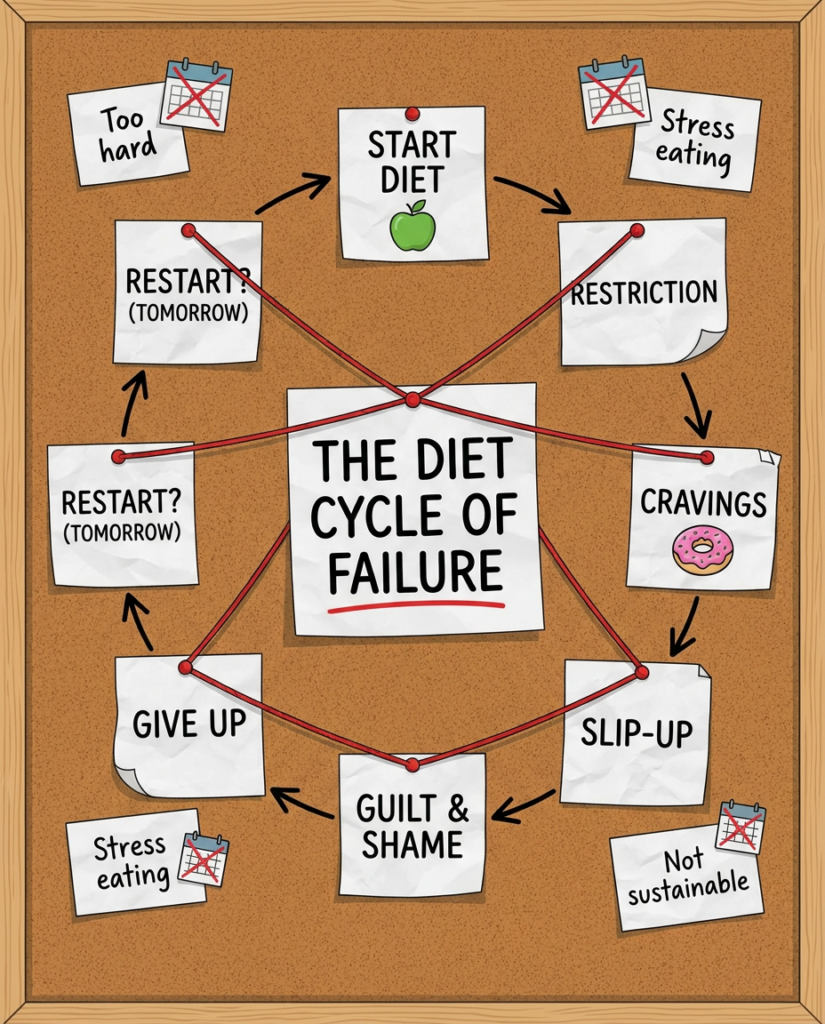
They restart after every lapse. A bad week becomes a reason to start from scratch next Monday. That creates a cycle of strict weeks and complete breaks, and over a year it adds up to very little.
They assume calm conditions. Regular schedules, predictable hunger and steady motivation. Real weeks bring travel, client dinners, sick kids and late meetings. When the demands of the plan exceed what the week leaves you, the plan breaks.
Four ways a diet falls apart
Too much at once. Cut carbs, track calories, prep every meal and train five times a week, all starting Monday. It works for a few days. Then one part breaks and takes the others with it.
Living by the streak. The diet feels intact only as long as the streak is. One client dinner or weekend trip breaks it, and instead of getting back on track at the next meal, you wait for a fresh start.
Tracking without changing habits. A food log shows you what you eat. It doesn’t change the routines that decide it, and for most busy men it’s the first thing to go in a hard week.
All or nothing. Either the diet is perfect or it’s blown. Psychologists have studied this for decades. In a classic experiment, dieters who were given a milkshake before a taste test ate more ice cream afterwards than dieters who got nothing, as if the day was already lost. Researchers later called it the what-the-hell effect. Rigid rules make it worse, because every small slip counts as a failure.
Motivation starts it, habits keep it going
The usual answer to a failed diet is to try harder and find a stronger reason. Motivation helps you start. It rises and falls with mood, sleep and stress, though, and a plan that only works when motivation is high will fail in the weeks you need it most.
A review of 100 theories of behavior change found that keeping a change going rests on different things than starting it: habits, routines that regulate themselves, the resources you have and the people and surroundings around you. Consistency is a skill you build with repetitions, the same way you build strength. How habits actually work explains why that’s more reliable than willpower.
What to build instead
Instead of another diet, build a simple setup that keeps running in bad weeks.
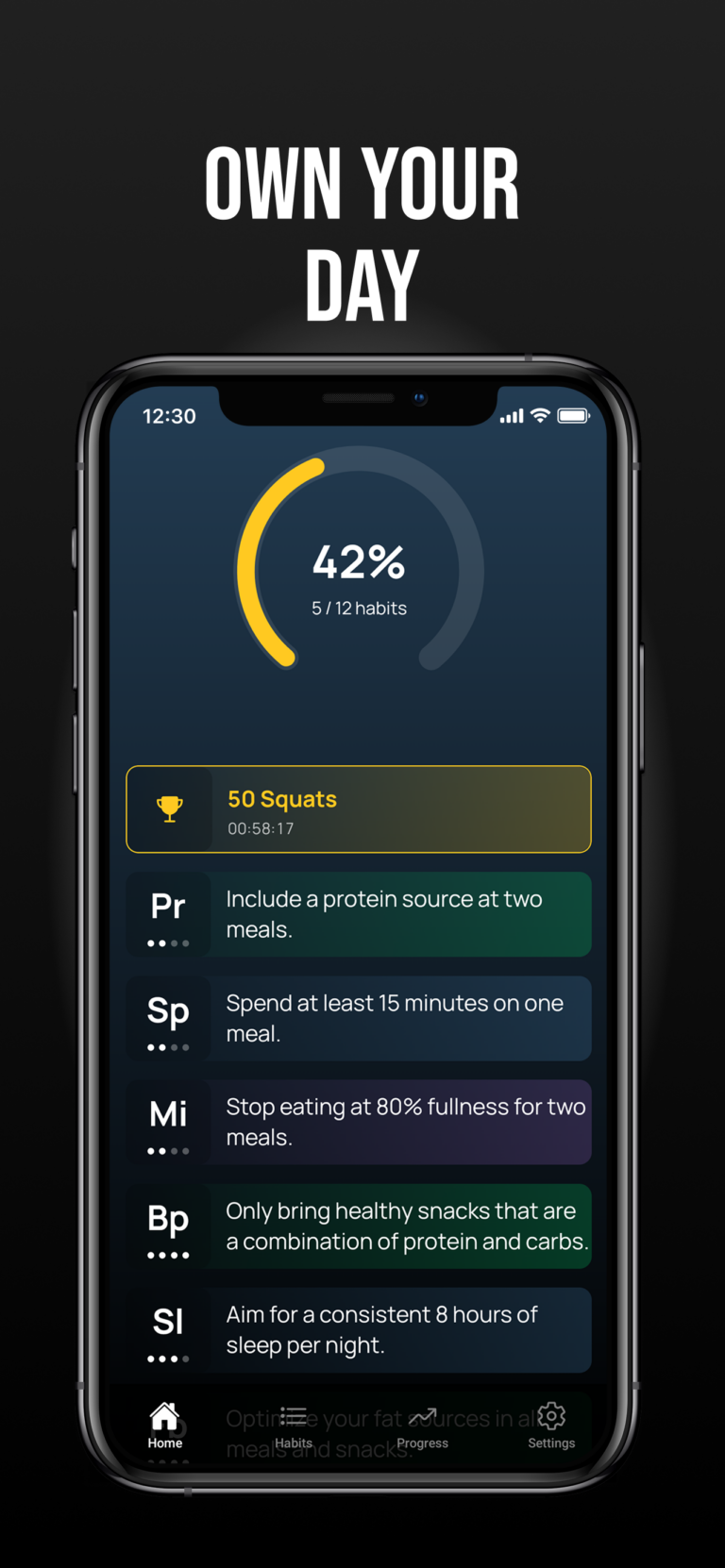
One anchor that always happens. A single behavior you do every day regardless of conditions. For most men, that’s a protein source at breakfast. It’s your floor, and everything else gets built on top of it. Eating habits that stick shows how to add the next steps.
Fallback meals. Decide now what you eat when you’re exhausted and have no plan: a rotisserie chicken with a bagged salad, eggs on toast, Greek yogurt with fruit, your standard order at the place near the office. When the fallback is already decided, a bad day doesn’t turn into a drive-through day.
Reps instead of resets. After a slip, the next meal is simply the next anchor. No recalculating, no new start date. Missing one gym session doesn’t hurt you, and skipping a whole week because you’re annoyed about missing one does. Food works the same way. Keep the gap short, so an off meal doesn’t become an off week.
Defaults instead of decisions. Every food choice that happens automatically is one less decision at the end of a long day. The fewer you make, the more consistent you get.
Count your wins and judge by months. A meta-analysis of 138 studies found that keeping track of progress toward a goal made people more likely to reach it, especially when they wrote it down or shared it with someone. Tick off your anchor each day and look back after a few weeks. Judge the result in months, too. If you judge by one week on the scale, you’ll drop approaches that work and restart ones that don’t.
Why men rarely ask for help with food
Many men will hire a business coach, a financial advisor or a personal trainer, but not help with food. Food feels personal, and asking for help with it can feel like admitting weakness. Men made up only about 27 percent of participants in lifestyle weight loss trials, even though they’re at least as likely as women to be overweight.
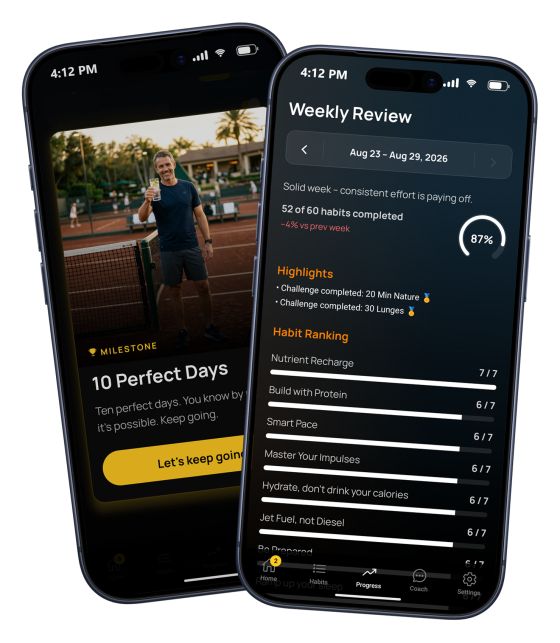
Coaching comes down to feedback and accountability, the same structure you use everywhere else at work. It shortens the trial and error and catches the moment you start drifting. That’s why the coach in the ZANE app checks in when you’ve gone quiet for three days, which is when most attempts quietly end.
The bottom line
A diet is something you’re on or off. A system is something you run. A week of travel or a month of stress makes it run worse for a while, but it keeps running. If you’ve quit diets before, you’ve learned that tools built for calm weeks don’t fit your life. Build one anchor, decide your fallbacks, get back on at the next meal and judge the result in months.
Sources
- Dansinger ML et al. Comparison of the Atkins, Ornish, Weight Watchers, and Zone diets for weight loss and heart disease risk reduction: a randomized trial. JAMA, 2005. doi:10.1001/jama.293.1.43
- Anderson JW et al. Long-term weight-loss maintenance: a meta-analysis of US studies. American Journal of Clinical Nutrition, 2001. doi:10.1093/ajcn/74.5.579
- Herman CP, Mack D. Restrained and unrestrained eating. Journal of Personality, 1975. doi:10.1111/j.1467-6494.1975.tb00727.x
- Kwasnicka D et al. Theoretical explanations for maintenance of behaviour change: a systematic review of behaviour theories. Health Psychology Review, 2016. doi:10.1080/17437199.2016.1151372
- Harkin B et al. Does monitoring goal progress promote goal attainment? A meta-analysis of the experimental evidence. Psychological Bulletin, 2016. doi:10.1037/bul0000025
- Pagoto SL et al. Male inclusion in randomized controlled trials of lifestyle weight loss interventions. Obesity, 2012. doi:10.1038/oby.2011.140
Jan B. is a sports scientist from the German Sport University Cologne and ZANE's CTO. Before building the app, he ran his own personal training studio in Cologne and taught more than 3,000 hours of group classes.
All articles by Jan B. →Your first habit is waiting
ZANE builds one nutrition habit at a time. No calorie counting, no meal logging. Try it free for 7 days.
Find your first habit