Protein & Muscle
How Much Protein Do Men Actually Need?
The official 0.8 g per kilo prevents deficiency. If you train, want to lose fat or are past 35, you need about twice that, and you can get there without counting.
 Jan W.Co-Founder and Head Coach of ZANE
- 5 min read
- 7 sources
In this article 9 sections
Key takeaways
- Men who train do best with 1.6 to 2.2 g of protein per kilo of body weight a day.
- In a diet and as you get older, stay at the upper end of that range.
- A palm-sized protein portion at every meal gets most men close without tracking.
- Protein keeps you full and costs more energy to digest than carbs or fat.
The official answer is 0.8 g of protein per kilo of body weight a day. For an 85 kg man, that’s 68 g.
That figure, the Recommended Dietary Allowance, is the amount that prevents a deficiency in a sedentary adult. It was never meant to help you keep muscle, lose fat or recover from training. For those goals you need considerably more. Here’s how much, and how to get there without counting.
Why the official number is too low for you
The RDA comes from nitrogen balance studies, which measure the minimum protein needed to avoid breaking down body tissue. It’s a floor. A man eating 0.8 g per kilo won’t become deficient, but he also won’t get the most out of his training, keep much muscle in a diet or benefit much from protein’s effect on hunger.
How much you actually need
If you train: 1.6 to 2.2 g per kilo a day. A large meta-analysis on protein and strength training found that gains in muscle levelled off at around 1.6 g per kilo, with 2.2 g covering nearly everyone. For an 85 kg man that’s 136 to 187 g. In pounds, it works out to roughly 0.7 to 1 g per pound.
If you’re losing weight: stay at the upper end. More protein helps you keep muscle while you’re in a deficit, and the International Society of Sports Nutrition recommends higher intakes for lean, trained men who are cutting. If you carry a lot of fat, base the number on your goal weight rather than your current weight.
As you get older: aim higher too. Older men need a larger dose per meal to get the same muscle-building response, and experts on aging recommend at least 1.0 to 1.2 g per kilo for people over 65 even if they don’t train. More on this in why your diet stopped working after 35.
What that looks like on a plate
Take an 85 kg man aiming for about 150 g a day. Spread over three meals, that’s around 50 g each. Some reference points, with meat and fish weighed raw:
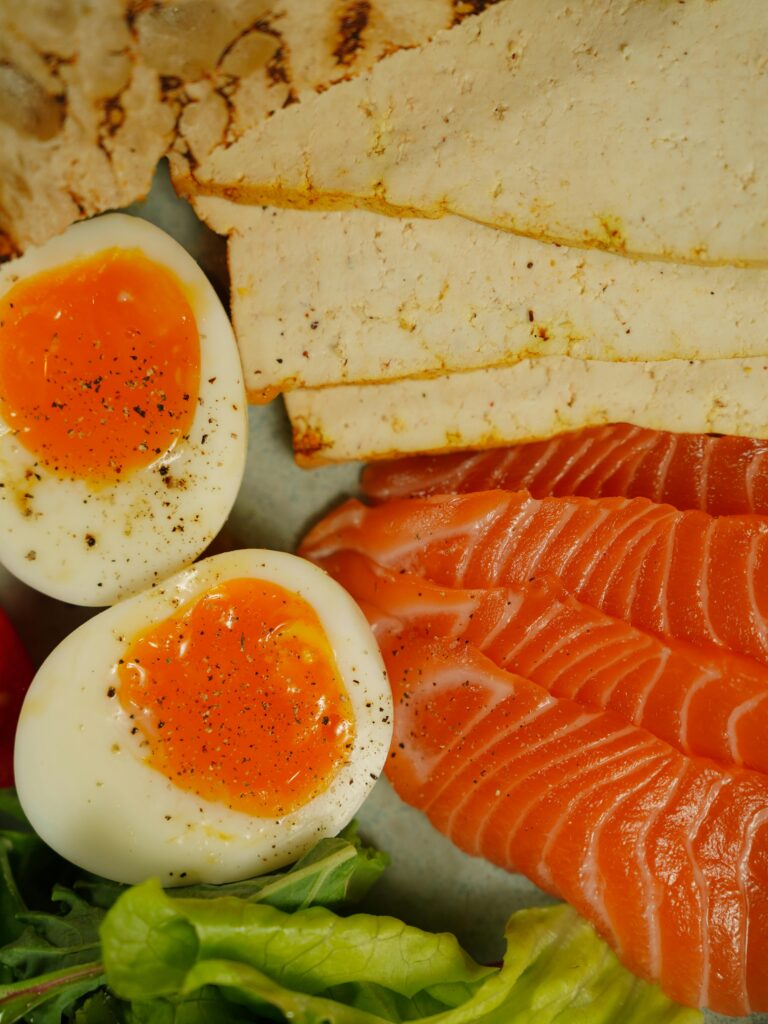
- 200 g chicken breast: about 46 g
- 250 g salmon: about 50 g
- 6 large eggs: about 36 g
- 300 g cottage cheese: about 35 g
- 200 g plain Greek yogurt and 2 eggs: about 30 g
- 40 g whey protein: about 30 to 32 g
You don’t need to weigh anything. A simple rule gets most men there: a palm-sized portion of protein at breakfast, lunch and dinner, and a second portion or a protein snack like Greek yogurt when you train. Men who build every meal around a real protein source usually land somewhere between 130 and 180 g without tracking.
Spread it over the day
Your total for the day matters most, but how you spread it counts too. In a study on protein after training, four servings of 20 g over twelve hours stimulated more muscle building than the same amount in two large servings.
That doesn’t mean a big serving is wasted. A 2023 study found that a 100 g dose kept the muscle-building response going for longer instead of hitting a ceiling. The practical takeaway: three or four protein-rich meals are a reliable way to cover your needs, and a larger dinner is fine. If you eat in a short window, fit three meals into it. The guide to intermittent fasting shows how.
Timing around training matters less than people think. A protein-rich meal in the hours after a session is enough.
The best sources for busy men
Two things make a protein source effective for muscle: it contains all essential amino acids, and it’s rich in leucine, the amino acid that most strongly switches on muscle building. Animal foods do well on both. Eggs, poultry, beef, pork, fish, Greek yogurt, cottage cheese and whey are all good choices, and canned tuna, sardines or mackerel are cheap and need no cooking.
Beans, lentils, tofu and tempeh count too. They have less leucine per gram, so you need a larger portion for the same effect, but they bring fiber, which most high-protein diets lack.
Protein is everywhere now. Do you need the bars?
Protein has turned into a marketing label. It’s in cereal, ice cream, chips and soda. Those products can be convenient, but they’re usually expensive and often ultra-processed, and a protein bar doesn’t fill you up like a plate of eggs or chicken does.
Build your intake on real food and use shakes or bars when there’s no better option. And watch what gets crowded out. Men who focus hard on protein often eat very little fiber, since meat, eggs and shakes contain none. What fibermaxxing gets right covers the easy fixes.
Why protein helps with weight loss
It fills you up. Protein is the most satiating nutrient per calorie. When researchers raised protein to 30 percent of calories, people ate about 440 fewer calories a day without being asked to eat less.
It costs more to digest. Your body uses about 20 to 30 percent of protein’s calories to process it, compared with 5 to 10 percent for carbohydrates and 0 to 3 percent for fat.
Together, that makes more protein one of the simplest changes with the biggest return, whether you want to get past a plateau or lose fat and build muscle at the same time.
The bottom line
The RDA is a minimum. If you train, want to lose fat or are past 35, aim for 1.6 to 2.2 g per kilo a day, spread over three or four meals. For an 85 kg man that’s 136 to 187 g, for a 90 kg man 144 to 198 g. You don’t need to count it. Build every meal around a real protein source and you’ll get close, which for many men means eating about half again as much protein as they do now.
Sources
- Morton RW et al. A systematic review, meta-analysis and meta-regression of the effect of protein supplementation on resistance training-induced gains in muscle mass and strength in healthy adults. British Journal of Sports Medicine, 2018. doi:10.1136/bjsports-2017-097608
- Jäger R et al. International Society of Sports Nutrition position stand: protein and exercise. Journal of the International Society of Sports Nutrition, 2017. doi:10.1186/s12970-017-0177-8
- Bauer J et al. Evidence-based recommendations for optimal dietary protein intake in older people: a position paper from the PROT-AGE Study Group. Journal of the American Medical Directors Association, 2013. doi:10.1016/j.jamda.2013.05.021
- Areta JL et al. Timing and distribution of protein ingestion during prolonged recovery from resistance exercise alters myofibrillar protein synthesis. The Journal of Physiology, 2013. doi:10.1113/jphysiol.2012.244897
- Trommelen J et al. The anabolic response to protein ingestion during recovery from exercise has no upper limit in magnitude and duration in vivo in humans. Cell Reports Medicine, 2023. doi:10.1016/j.xcrm.2023.101324
- Weigle DS et al. A high-protein diet induces sustained reductions in appetite, ad libitum caloric intake, and body weight despite compensatory changes in diurnal plasma leptin and ghrelin concentrations. American Journal of Clinical Nutrition, 2005. doi:10.1093/ajcn/82.1.41
- Westerterp KR. Diet induced thermogenesis. Nutrition and Metabolism, 2004. doi:10.1186/1743-7075-1-5
Jan W. is a sports scientist from the German Sport University Cologne and has coached for 20 years, from busy professionals to pro athletes. He has lived on Hawaii for over a decade and has the final word on everything training-related at ZANE.
All articles by Jan W. →Your first habit is waiting
ZANE builds one nutrition habit at a time. No calorie counting, no meal logging. Try it free for 7 days.
Find your first habit