Sleep & Stress
Why Stress Gives You a Belly (The Cortisol-Fat Connection)
Chronic stress affects where fat ends up and how well a diet works. Why dieting harder under stress often backfires, and what helps instead.
 Jan W.Co-Founder and Head Coach of ZANE
- 4 min read
- 6 sources

In this article 7 sections
Key takeaways
- Visceral fat responds more strongly to cortisol than the fat under your skin.
- Higher long-term cortisol went along with larger waists in a study of more than 2,500 adults.
- Short sleep, too much hard training and lots of caffeine keep cortisol high.
- Sleep, walking and a moderate deficit with enough protein work better than more restriction.
Many men with a stubborn belly eat less than they used to and train more than they did five years ago. The belly stays anyway.
They blame willpower, age or not being strict enough. Chronic stress is often part of the answer. It doesn’t replace calories as the main driver of fat gain, but it affects where fat ends up, how hungry you are and how well a diet works. Here’s how that happens and what actually helps.
What cortisol does
Cortisol is a hormone made by the adrenal glands in response to stress of any kind: physical, psychological or metabolic. In the short term it’s useful. It raises blood sugar for energy, sharpens attention and damps down inflammation.
The stress response evolved for threats that ended. Most men today carry stress that doesn’t end: the back-to-back calendar, the 11 p.m. email, broken sleep and deadlines that never resolve, just rotate. When cortisol stays high for weeks instead of spiking and falling, it stops helping.
Why stress shows up around the waist
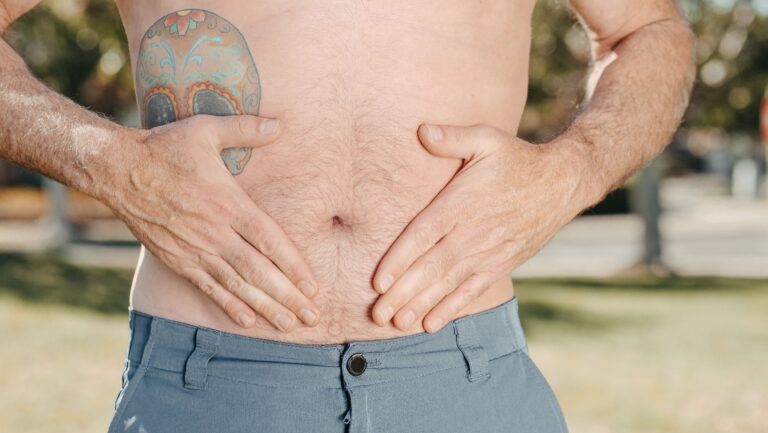
Cortisol doesn’t spread fat evenly. The deep fat around your organs, called visceral fat, has more receptors for cortisol than the fat under your skin, so it responds more strongly to the signal. The extreme case is Cushing’s syndrome, where the body makes far too much cortisol and fat collects around the trunk.
Everyday stress is far milder, but the link shows up there too. In a study of more than 2,500 men and women over 54, those with higher long-term cortisol levels, measured in their hair, had larger waists and a higher BMI. And in lab studies, people who react to stress with larger cortisol spikes tend to carry more fat around the middle.
Stress also works through behavior. It pushes many people toward sweet, fatty comfort food and weakens impulse control at the same time. How to stop stress eating covers that side.
Why dieting harder can backfire
A stressed man cuts calories hard. But dieting is a stressor too. In a study of women on a 1,200-calorie diet for three weeks, cortisol output rose, and simply having to track calories made them feel more stressed.
A calorie deficit still works. But a man eating 1,600 calories, training six days a week and sleeping five hours a night while running a company is stacking every stressor at once. Hunger rises, recovery drops and the diet usually breaks before the belly does. The problem is less the diet itself than the conditions it’s running in. The real reason you hit a plateau covers the other usual causes.
What keeps cortisol high
Short sleep. After a night of restricted or no sleep, cortisol stays elevated into the next evening, when it should be falling. String together a week of short nights and it never gets a chance to settle. How sleep deprivation makes you fat explains the rest of what that does.
Too much hard training. Cortisol rises during exercise mainly above moderate intensity. Hard sessions are fine with enough recovery. Long, intense sessions day after day on little sleep keep it up.
Lots of caffeine. Caffeine raises cortisol. Regular coffee drinkers get partly used to it, but not completely. A morning coffee is fine. Four coffees to get through a day on five hours of sleep add to a load that’s already high.
Alcohol. It breaks up sleep in the second half of the night, which feeds the sleep problem above. See what alcohol does to your body composition.
What helps
Sleep first. Seven to nine hours is the biggest lever you have. No nutrition strategy reliably makes up for chronically short nights.
A moderate deficit with enough protein. Cut a few hundred calories, not a thousand, and eat protein at every meal. That protects muscle, keeps hunger manageable and makes the diet less of a stressor. See how much protein men actually need.
Walk. Low-intensity exercise lowers cortisol rather than raising it. Twenty to thirty minutes of walking after a hard day burns calories without adding stress. Why walking works for fat loss has more.
Train smarter, not more. Three to four well-planned strength sessions a week with enough sleep get better results under stress than six hard sessions with poor recovery.
Cap the caffeine. Keep coffee to the first half of the day and don’t use it to replace sleep.
The bottom line
A belly that won’t budge despite reasonable eating and regular training often has stress and short sleep behind it, not just a willpower problem. More restriction rarely fixes it. Lower the stress load, protect your sleep, train smarter, walk more and keep the deficit moderate with plenty of protein. That gives your body a reason to let go of the fat around your middle.
Sources
- Jackson SE et al. Hair cortisol and adiposity in a population-based sample of 2,527 men and women aged 54 to 87 years. Obesity, 2017. doi:10.1002/oby.21733
- Epel ES et al. Stress and body shape: stress-induced cortisol secretion is consistently greater among women with central fat. Psychosomatic Medicine, 2000. doi:10.1097/00006842-200009000-00005
- Tomiyama AJ et al. Low calorie dieting increases cortisol. Psychosomatic Medicine, 2010. doi:10.1097/PSY.0b013e3181d9523c
- Leproult R et al. Sleep loss results in an elevation of cortisol levels the next evening. Sleep, 1997. doi:10.1093/sleep/20.10.865
- Hill EE et al. Exercise and circulating cortisol levels: the intensity threshold effect. Journal of Endocrinological Investigation, 2008. doi:10.1007/BF03345606
- Lovallo WR et al. Caffeine stimulation of cortisol secretion across the waking hours in relation to caffeine intake levels. Psychosomatic Medicine, 2005. doi:10.1097/01.psy.0000181270.20036.06
Jan W. is a sports scientist from the German Sport University Cologne and has coached for 20 years, from busy professionals to pro athletes. He has lived on Hawaii for over a decade and has the final word on everything training-related at ZANE.
All articles by Jan W. →Your first habit is waiting
ZANE builds one nutrition habit at a time. No calorie counting, no meal logging. Try it free for 7 days.
Find your first habit