Longevity
Are Seed Oils Actually Bad for You? The Evidence
Seed oils are blamed for inflammation and heart disease. Controlled trials tell a different story, but the critics are right about fried and processed food.
 Jan W.Co-Founder and Head Coach of ZANE
- 5 min read
- 8 sources
In this article 8 sections
Key takeaways
- In randomized trials, more linoleic acid didn't raise inflammation markers in healthy people.
- Replacing saturated fat with polyunsaturated fat tends to lower heart disease risk.
- Extra virgin olive oil has the strongest trial evidence of any cooking fat.
- Cutting ultra-processed and deep-fried food matters more than which oil you cook with.
Few topics in nutrition are as tribal as seed oils.
One camp says vegetable and seed oils are behind obesity, heart disease and chronic inflammation, because their rise in the food supply tracks the rise of modern disease. The other camp, mainstream nutrition science, has recommended polyunsaturated fats like those in seed oils over saturated fat for decades.
Both sides simplify. Here’s what the trials and large studies found, without the politics, and what it means for your kitchen.
What seed oils are
The term covers canola, soybean, sunflower, corn, cottonseed, safflower and grapeseed oil. They’re pressed from seeds, unlike olive oil (from a fruit) or butter, lard and tallow (from animals).
They’re high in polyunsaturated fat, mostly the omega-6 fat linoleic acid. Canola also contains a fair amount of plant omega-3. Because they’re cheap and keep well, they’re the main fat in processed and restaurant food, and Americans eat far more of them than a century ago.
The inflammation argument
The main case against seed oils goes like this: omega-6 fats can be turned into compounds that promote inflammation, modern diets contain far more omega-6 than omega-3, so seed oils must drive chronic inflammation.
It sounds logical, but controlled trials don’t bear it out. A systematic review of randomized trials in healthy people found that eating more linoleic acid didn’t raise markers of inflammation in the blood. The American Heart Association reviewed the evidence and concluded that getting 5 to 10 percent of calories from omega-6 fats lowers heart disease risk rather than raising it.
Large observational data point the same way. In a pooled analysis of 30 studies that measured linoleic acid in people’s blood rather than asking what they ate, higher levels went along with a lower risk of heart disease and death.
Many people do eat too little omega-3. That’s worth fixing, but by eating more of it, not by fearing omega-6.
Where the critics have a point: heat
Polyunsaturated fats are less stable under heat than saturated or monounsaturated fats. When oil is heated to frying temperatures again and again, it forms oxidation products that have been linked to cell damage in animal studies.
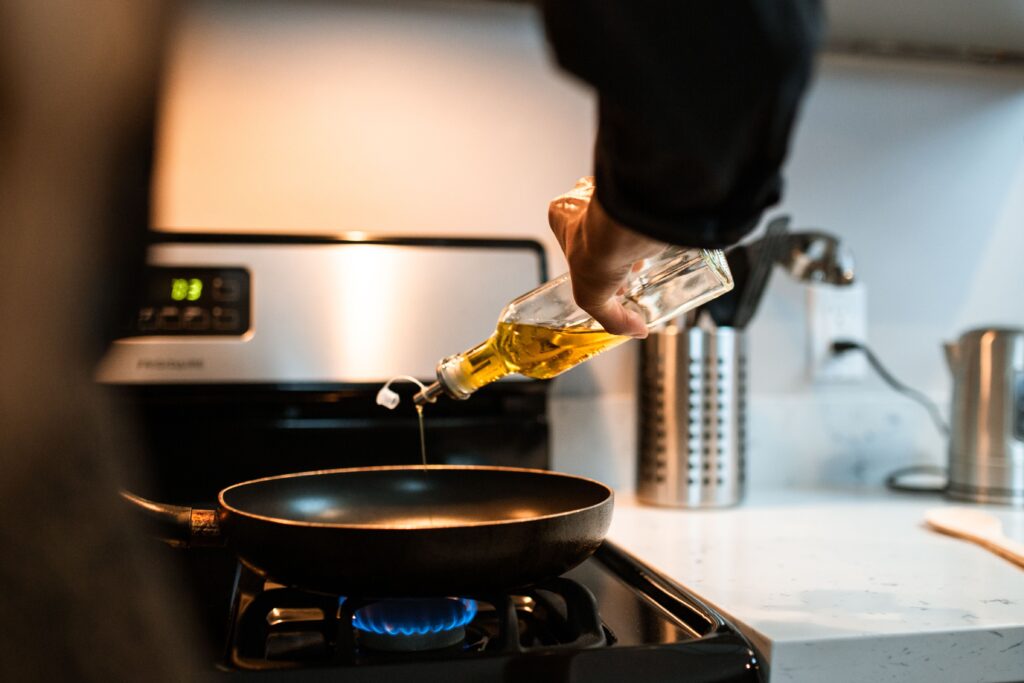
That mostly concerns deep-fryer oil in restaurants and fast food chains, which is reused for hours or days. A splash of fresh oil in a pan at home produces far less, and a salad dressing none at all.
What the big trials show
The trial critics cite most is the Minnesota Coronary Experiment from 1968 to 1973. It replaced saturated fat with corn oil, lowered cholesterol and still showed no fewer deaths. When the full data were finally analyzed in 2016, older participants on corn oil even had a higher risk of dying. The trial has real limits, though. Most participants took part for only about a year, and many dropped out early.
Looking at all the trials together gives a different picture. A Cochrane review found that cutting saturated fat lowered the risk of heart attacks and strokes by about 17 percent, with the clearest benefit when it was replaced by polyunsaturated fat, and no benefit when it was replaced by refined carbs. That last point explains a lot about the low-fat era: people swapped butter for white bread and sugar.
The fat with the strongest trial evidence is olive oil. In the PREDIMED trial, a Mediterranean diet with extra virgin olive oil lowered the rate of heart attacks, strokes and cardiovascular deaths by about 30 percent compared with a low-fat diet.
What about butter and tallow?
Part of the seed oil debate has turned into a comeback for butter, lard and beef tallow. Butter isn’t the villain it was made out to be. In a meta-analysis, it had little link to heart disease and a small link to overall mortality. But saturated fat raises LDL cholesterol, and the trial evidence favors replacing it rather than adding more. Butter on your eggs is fine. Making butter and tallow your main cooking fats isn’t supported by the evidence.
What to do in practice
Make olive oil your main fat. Extra virgin for salads and everyday cooking. For very high heat, refined olive oil or avocado oil hold up well.
Eat more omega-3 from fish. Salmon, sardines, mackerel or trout twice a week. Fish oil capsules are less convincing. In a large trial in healthy adults, they didn’t reduce heart attacks or strokes overall.
Eat less processed food. This is the change that matters most. Seed oils are in nearly every ultra-processed product and in most fried restaurant food. If you eat mostly whole, minimally processed food, your seed oil intake drops a lot whatever you cook with, along with the sugar, refined flour and salt that come in the same package. Your gut bacteria benefit too, as gut health for men explains.
Go easy on deep-fried food. Not because of the oil type alone, but because reused frying oil and the calories that come with it add up.
Don’t worry about the canola in your dressing. A little seed oil in home cooking isn’t a meaningful health risk based on current evidence.
The bottom line
The case against seed oils as such is weaker than social media suggests. Trials don’t show that linoleic acid causes inflammation, and replacing saturated fat with polyunsaturated fat tends to lower heart risk. The critics are right about one thing: much of the seed oil Americans eat comes in fried and ultra-processed food, and that food is a problem for many reasons. Cook mainly with olive oil, eat fish twice a week and cut back on processed food. That covers the concerns of both camps. For what a whole-food approach looks like day to day, see how to lose weight without counting calories.
Sources
- Johnson GH, Fritsche K. Effect of dietary linoleic acid on markers of inflammation in healthy persons: a systematic review of randomized controlled trials. Journal of the Academy of Nutrition and Dietetics, 2012. doi:10.1016/j.jand.2012.03.029
- Harris WS et al. Omega-6 fatty acids and risk for cardiovascular disease: a science advisory from the American Heart Association. Circulation, 2009. doi:10.1161/CIRCULATIONAHA.108.191627
- Marklund M et al. Biomarkers of dietary omega-6 fatty acids and incident cardiovascular disease and mortality. Circulation, 2019. doi:10.1161/CIRCULATIONAHA.118.038908
- Ramsden CE et al. Re-evaluation of the traditional diet-heart hypothesis: analysis of recovered data from Minnesota Coronary Experiment (1968-73). BMJ, 2016. doi:10.1136/bmj.i1246
- Hooper L et al. Reduction in saturated fat intake for cardiovascular disease. Cochrane Database of Systematic Reviews, 2020. doi:10.1002/14651858.CD011737.pub3
- Estruch R et al. Primary prevention of cardiovascular disease with a Mediterranean diet supplemented with extra-virgin olive oil or nuts. New England Journal of Medicine, 2018. doi:10.1056/NEJMoa1800389
- Pimpin L et al. Is butter back? A systematic review and meta-analysis of butter consumption and risk of cardiovascular disease, diabetes, and total mortality. PLoS One, 2016. doi:10.1371/journal.pone.0158118
- Manson JE et al. Marine n-3 fatty acids and prevention of cardiovascular disease and cancer. New England Journal of Medicine, 2019. doi:10.1056/NEJMoa1811403
Jan W. is a sports scientist from the German Sport University Cologne and has coached for 20 years, from busy professionals to pro athletes. He has lived on Hawaii for over a decade and has the final word on everything training-related at ZANE.
All articles by Jan W. →Your first habit is waiting
ZANE builds one nutrition habit at a time. No calorie counting, no meal logging. Try it free for 7 days.
Find your first habit