Longevity
Gut Health for Men: What It Actually Affects
Your gut bacteria affect fullness, inflammation and possibly mood. Some popular claims hold up, some don't. Here's what the research supports and what to eat.
In this article 9 sections
Key takeaways
- Gut bacteria turn fiber into short-chain fatty acids that protect the gut lining and help you feel full.
- About 97 percent of American men eat less fiber than the recommended 38 grams a day.
- People who ate more than 30 different plant foods a week had more varied gut bacteria.
- Healthy men rarely need a probiotic. Fiber and fermented foods come first.
Gut health comes with a lot of noise: probiotic marketing, kombucha, wellness brands and a habit of calling anything digestive “the gut.”
Underneath the noise is a real system that researchers have learned a lot about in the last fifteen years. Some of the popular claims hold up, some are overstated and a few are wrong. Here’s the version without the hype: what your gut bacteria affect, what harms them and what you can do about it.
What the gut microbiome is
Your large intestine is home to roughly 38 trillion bacteria, about as many as the cells of your body, along with fungi and viruses. Together they weigh only about 0.2 kg, but they’re metabolically busy. They break down what you can’t digest yourself and produce compounds that reach the rest of the body.
The mix differs a lot from man to man. Genetics, birth, early diet, antibiotics and what you eat now all shape it. It also responds quickly. In one study, switching people to an all-animal or all-plant diet changed their gut bacteria within a day.
Body weight and metabolism
The best-known experiment used twins in which one was lean and one was obese. Mice that received gut bacteria from the obese twin gained more fat than mice that received bacteria from the lean twin. That shows the microbiome can influence weight, at least in mice. The popular shortcut, that a certain ratio of two bacterial groups makes people fat, hasn’t held up consistently in human studies.
The better-supported mechanism runs through fiber. When your bacteria ferment fiber, they produce short-chain fatty acids such as butyrate, propionate and acetate. These feed the cells of the gut lining, help keep the gut barrier intact and trigger hormones that signal fullness.
Inflammation
The gut lining is a single layer of cells between the contents of your intestine and your bloodstream. When it lets through more than it should, bacterial fragments can reach the blood and set off low-grade inflammation, which is linked to insulin resistance and heart disease. The term “leaky gut” gets used loosely online, and much of the mechanism comes from animal studies. But the direction is consistent: a diet low in fiber and high in ultra-processed food, plus heavy drinking, works against the barrier. Fiber and plant variety support it.
Mood and focus
The gut and brain do communicate, through the vagus nerve, the immune system and compounds made by bacteria. You’ll often read that 95 percent of your serotonin is made in the gut. Most of the body’s serotonin is indeed produced there, but it doesn’t cross into the brain. Gut serotonin mainly controls digestion, so it doesn’t explain your mood.
The evidence on mood is modest. A meta-analysis of clinical trials found that probiotics produced a small improvement in symptoms of depression and none for anxiety. Your gut is one of many factors in how you feel and a poor substitute for sleep, exercise or real mental health care.
What harms your gut bacteria
Too little fiber. Fiber is the main food for many of your beneficial bacteria. Men up to 50 are advised to eat 38 grams a day and men over 50 30 grams, and about 97 percent of American men fall short. Men who build every meal around protein often eat even less, because meat, eggs and shakes contain none.
Ultra-processed food. It’s usually low in fiber, and some additives may affect gut bacteria directly. In a controlled feeding study, healthy adults who ate the common emulsifier carboxymethylcellulose for eleven days had fewer types of gut bacteria and fewer beneficial compounds in their stool than a group eating the same diet without it.
Antibiotics. Sometimes they’re necessary, and then you take them. They do knock out part of the microbiome. In healthy men given a course of antibiotics, most bacteria came back within about six weeks, but some species were still missing six months later. A common tip is to take a probiotic afterwards. In one study that actually slowed recovery of the gut’s own bacteria. Eating plenty of fiber is the safer bet.
Heavy drinking. Regular heavy drinking damages the gut barrier and shifts the bacterial mix in an unfavorable direction. See what alcohol does to your body composition.
What helps
More kinds of plants. In a large citizen science project, people who ate more than 30 different plant foods a week had more varied gut bacteria than those who ate fewer than ten. The data are observational, but the advice is low-risk. Different fibers feed different bacteria. Plant foods include vegetables, fruit, beans, whole grains, nuts, seeds, herbs and spices, so the number adds up faster than it sounds. Rotate what you already eat: swap spinach for arugula or kale, rice for lentils or chickpeas, one fish for mackerel or sardines.
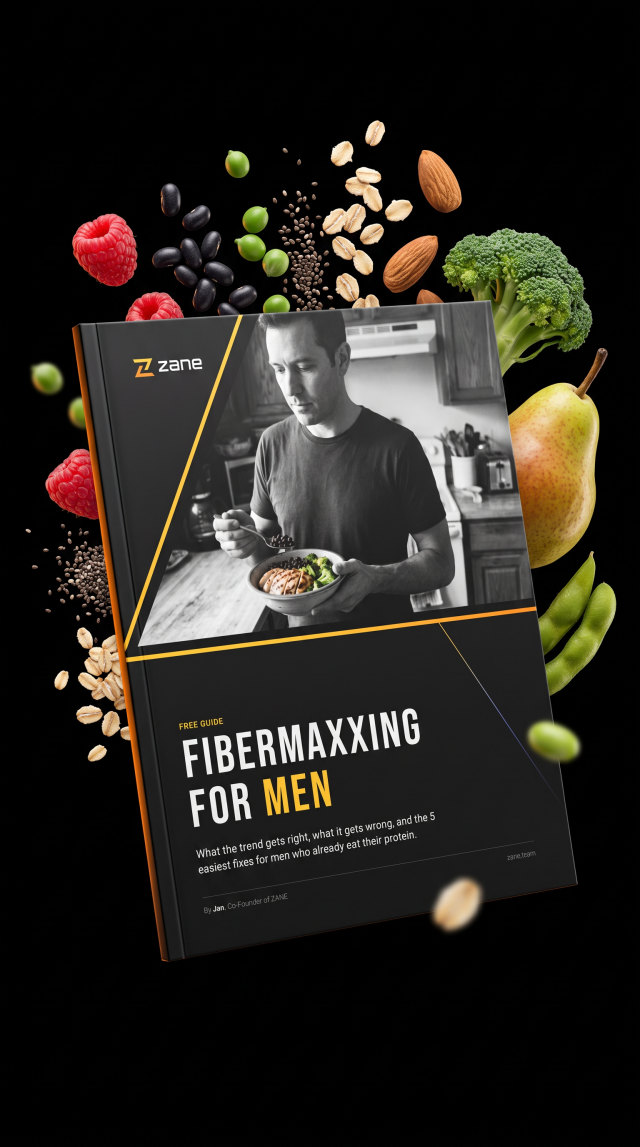
Enough fiber. Beans and lentils, oats, frozen broccoli or peas, pears and apples are the easiest sources. Onions, garlic, leeks, asparagus and slightly green bananas are rich in the fibers your bacteria like most. Increase slowly, by about 5 to 10 grams a week, or you’ll mostly notice gas. What fibermaxxing gets right covers how much makes sense.
Fermented foods. Yogurt, kefir, kimchi, sauerkraut and similar foods contain live bacteria. In a ten-week study at Stanford, adults who ate about six servings of fermented foods a day ended up with more varied gut bacteria and lower levels of 19 inflammatory markers. A high-fiber diet didn’t increase diversity in the same time frame. Six servings a day is a lot. A daily serving or two is a realistic start, and Greek yogurt covers protein at the same time.
Less ultra-processed food. You don’t need to cut it out completely. Replacing a few processed snacks and meals with higher-fiber options over a few months is more realistic than a pristine diet overnight.
Do you need a probiotic?
Probably not. For specific medical situations, certain strains have solid evidence, for example to lower the risk of a C. difficile infection during antibiotic treatment. That’s a question for your doctor. For healthy men, there’s no good evidence that a daily probiotic improves anything, and products vary widely in what they contain. Fermented foods and fiber come first.
The bottom line
Gut health is real physiology, and much of it is less exotic than the marketing suggests. Your bacteria need fiber and variety, they don’t like a diet built on ultra-processed food and heavy drinking, and they respond within days when you change what you eat. The fixes are simple: more kinds of plants, enough fiber, some fermented food and fewer processed products. They’re the same habits that improve body composition. If you already eat plenty of protein, how much protein men actually need shows how to keep it there while you add the fiber.
Sources
- Sender R et al. Revised estimates for the number of human and bacteria cells in the body. PLoS Biology, 2016. doi:10.1371/journal.pbio.1002533
- David LA et al. Diet rapidly and reproducibly alters the human gut microbiome. Nature, 2014. doi:10.1038/nature12820
- Ridaura VK et al. Gut microbiota from twins discordant for obesity modulate metabolism in mice. Science, 2013. doi:10.1126/science.1241214
- Koh A et al. From dietary fiber to host physiology: short-chain fatty acids as key bacterial metabolites. Cell, 2016. doi:10.1016/j.cell.2016.05.041
- Yano JM et al. Indigenous bacteria from the gut microbiota regulate host serotonin biosynthesis. Cell, 2015. doi:10.1016/j.cell.2015.02.047
- Liu RT et al. Prebiotics and probiotics for depression and anxiety: a systematic review and meta-analysis of controlled clinical trials. Neuroscience & Biobehavioral Reviews, 2019. doi:10.1016/j.neubiorev.2019.03.023
- Quagliani D, Felt-Gunderson P. Closing America's fiber intake gap: communication strategies from a Food and Fiber Summit. American Journal of Lifestyle Medicine, 2017. doi:10.1177/1559827615588079
- Chassaing B et al. Randomized controlled-feeding study of dietary emulsifier carboxymethylcellulose reveals detrimental impacts on the gut microbiota and metabolome. Gastroenterology, 2022. doi:10.1053/j.gastro.2021.11.006
- Palleja A et al. Recovery of gut microbiota of healthy adults following antibiotic exposure. Nature Microbiology, 2018. doi:10.1038/s41564-018-0257-9
- Suez J et al. Post-antibiotic gut mucosal microbiome reconstitution is impaired by probiotics and improved by autologous FMT. Cell, 2018. doi:10.1016/j.cell.2018.08.047
- McDonald D et al. American Gut: an open platform for citizen science microbiome research. mSystems, 2018. doi:10.1128/mSystems.00031-18
- Wastyk HC et al. Gut-microbiota-targeted diets modulate human immune status. Cell, 2021. doi:10.1016/j.cell.2021.06.019
- Goldenberg JZ et al. Probiotics for the prevention of Clostridium difficile-associated diarrhea in adults and children. Cochrane Database of Systematic Reviews, 2017. doi:10.1002/14651858.CD006095.pub4

Has coached men on nutrition for 20 years and built ZANE's habit system from that work. (Placeholder)
All articles by Jan W. →Your first habit is waiting
ZANE builds one nutrition habit at a time. No calorie counting, no meal logging. Try it free for 7 days.
Start 7 days free