Fat Loss
How to Lose Weight Without Counting Calories
Counting works on paper and breaks down in a busy life. These are the habits that lower your intake without logging a single meal.
 Jan W.Co-Founder and Head Coach of ZANE
- 6 min read
- 7 sources

In this article 8 sections
Key takeaways
- Calorie counting fails for most men because it needs constant logging, not because the math is wrong.
- Protein at every meal and water as your default drink lower your intake without any tracking.
- Short sleep raises hunger hormones, so fixing sleep makes your appetite easier to trust.
- Weigh yourself weekly and judge the four-week trend, not the daily number.
You already know how weight loss works on paper: eat less than you burn, every day, until the scale moves.
The math is fine. The effort is what breaks it. Counting calories properly means weighing food, logging every meal and keeping that up for months, on top of a job, a family and a calendar that rarely goes to plan. Most men manage it for a few weeks and then stop.
This article is for men who have tried tracking and don’t want to do it again. It covers why counting breaks down in real life and which habits lower your intake without a single number.
Why calorie counting breaks down
Counting has its uses. Knowing roughly what you eat helps, and people who keep an eye on their intake tend to make better choices. The trouble is the work it takes to do it well.
You have to weigh portions and log everything, including the coffee before your 8 a.m. call, the handful of nuts in the afternoon and the sauce on a restaurant dish you can’t look up. Then a hard week arrives with a deadline, a trip or three client dinners, and the log stays empty. A system that needs constant input stops working the moment the input stops.
Every logged meal is also one more decision in a day that already has plenty of them. Over weeks that load adds up, and food turns into one more thing you have to manage.
The numbers are also less precise than they look. In a study published in the New England Journal of Medicine, people who were sure they ate under 1,200 calories a day had underreported their intake by almost half. Restaurant meals are close to impossible to log accurately. You end up doing a lot of admin for figures that can be off by hundreds of calories.
What actually drives weight loss
Calories still decide the outcome. The behaviors that set your intake matter more than writing the intake down.
The National Weight Control Registry follows thousands of people who lost at least 30 pounds and kept it off for at least a year. What they have in common are steady routines. Most eat breakfast, keep a similar eating pattern on weekdays and weekends, stay active and weigh themselves at least once a week.
Four levers do most of the work:
Protein at every meal. Protein fills you up more than carbs or fat do. When researchers raised protein to 30 percent of calories, people ate about 440 fewer calories a day on their own, without being told to eat less. If you’re unsure how much you need, start with how much protein men actually need.
Water as your default drink. Calories from drinks barely register as food. In a controlled trial, adding 450 calories a day as soda led to weight gain, while the same calories as jelly beans were largely offset because people ate less at meals. Swapping two sodas and two sweetened coffees a day for water and plain coffee creates a daily deficit without logging anything.
Regular meal times. Think of it as a rough rhythm rather than a fasting protocol: a standard breakfast, a planned lunch and dinner at about the same time most days. Fixed defaults take dozens of small food decisions off your plate, and fewer decisions leave fewer chances to grab whatever happens to be nearby.
What’s in your kitchen. If chips are in the cupboard, you’ll eat chips. If eggs, Greek yogurt and fruit are the easiest things to grab, you’ll eat those instead. Change what’s at home and your intake changes with it.
Why extreme diets don’t fix this
Carnivore, strict keto and aggressive fasting plans feel decisive, and the first weeks often go well. Much of that early result comes from cutting out processed food and sugar, which any sensible plan does as well.
The weak spot is the rulebook. With rigid rules, one slip feels like failure, and failure feels like a reason to quit or to start over on Monday. You learn which foods to avoid, but you don’t build the routines that carry you through a busy week. When the diet ends, your old habits are still waiting.
A four-week start without tracking
Add one change per week. By the end of the month they run without much thought.
Week 1: add a protein anchor. Pick the meal you handle worst, often breakfast or lunch, and add a real protein source: eggs, Greek yogurt, chicken or cottage cheese. It sets a floor for that meal and leaves you less hungry later in the day.
Week 2: make water the default. Coffee stays. Sweetened drinks become something you choose on purpose instead of reaching for them out of habit.
Week 3: give lunch a structure. Protein, vegetables and one carb. The foods change with your week, the structure stays the same.
Week 4: slow dinner down. Start with protein and vegetables and take your time. A review of 22 studies found that people eat less in a meal when they eat more slowly.
From then on, one daily question replaces the calorie log: did I get my core habits done today? Protein at each meal, water as the default, a regular bedtime. If the answer is mostly yes, your intake is taking care of itself.
Fix your hunger signal
Part of counting’s appeal is that it gives you rules when your hunger feels unreliable. Hunger does become unreliable when you sleep badly, live with constant stress, eat a lot of ultra-processed food or eat at random times.
Sleep has an outsized effect. After two nights of four hours in bed, young men in one study had lower levels of the fullness hormone leptin, higher levels of the hunger hormone ghrelin and a stronger appetite, especially for calorie-dense carbs. There’s more on this in how sleep deprivation makes you fat.
Ultra-processed food pushes in the same direction. In a month-long study at the US National Institutes of Health, people spent two weeks on an ultra-processed diet and two weeks on an unprocessed one. Both were offered in unlimited amounts and matched for calories, sugar, fat and fiber, yet people ate about 500 more calories a day on the ultra-processed diet.
Sleep at regular times, cut back on ultra-processed food and eat on a rough schedule, and your hunger becomes a useful guide again. If stress is what drives your evening snacking, start with how to stop stress eating.
How to read the scale
Your weight is useful data, but it is noisy. Water, stored carbohydrate, salt, training and stress move it by several pounds from one day to the next, regardless of how much fat you lost.
Weigh yourself once a week on the same day, at the same time and under the same conditions, and judge the four-week trend instead of single readings. With these habits in place, the trend usually starts to move within four to six weeks. If it stalls for longer than that, read the real reason you hit a weight loss plateau.
The bottom line
If counting calories works for you and you can keep it up, carry on. If you’ve tried it and dropped it after a month, trying harder rarely helps. A different tool usually does.
Build the habits that set your intake: protein at every meal, water as your default drink, regular meals, a kitchen that works for you and enough sleep. The calories follow. For the psychology behind making these changes stick, read how habits actually work.
Sources
- Lichtman SW et al. Discrepancy between self-reported and actual caloric intake and exercise in obese subjects. New England Journal of Medicine, 1992. doi:10.1056/NEJM199212313272701
- Wing RR, Phelan S. Long-term weight loss maintenance. American Journal of Clinical Nutrition, 2005. doi:10.1093/ajcn/82.1.222S
- Weigle DS et al. A high-protein diet induces sustained reductions in appetite, ad libitum caloric intake, and body weight despite compensatory changes in diurnal plasma leptin and ghrelin concentrations. American Journal of Clinical Nutrition, 2005. doi:10.1093/ajcn/82.1.41
- DiMeglio DP, Mattes RD. Liquid versus solid carbohydrate: effects on food intake and body weight. International Journal of Obesity, 2000. doi:10.1038/sj.ijo.0801229
- Robinson E et al. A systematic review and meta-analysis examining the effect of eating rate on energy intake and hunger. American Journal of Clinical Nutrition, 2014. doi:10.3945/ajcn.113.081745
- Spiegel K et al. Sleep curtailment in healthy young men is associated with decreased leptin levels, elevated ghrelin levels, and increased hunger and appetite. Annals of Internal Medicine, 2004. doi:10.7326/0003-4819-141-11-200412070-00008
- Hall KD et al. Ultra-processed diets cause excess calorie intake and weight gain: an inpatient randomized controlled trial of ad libitum food intake. Cell Metabolism, 2019. doi:10.1016/j.cmet.2019.05.008
Jan W. is a sports scientist from the German Sport University Cologne and has coached for 20 years, from busy professionals to pro athletes. He has lived on Hawaii for over a decade and has the final word on everything training-related at ZANE.
All articles by Jan W. →Your first habit is waiting
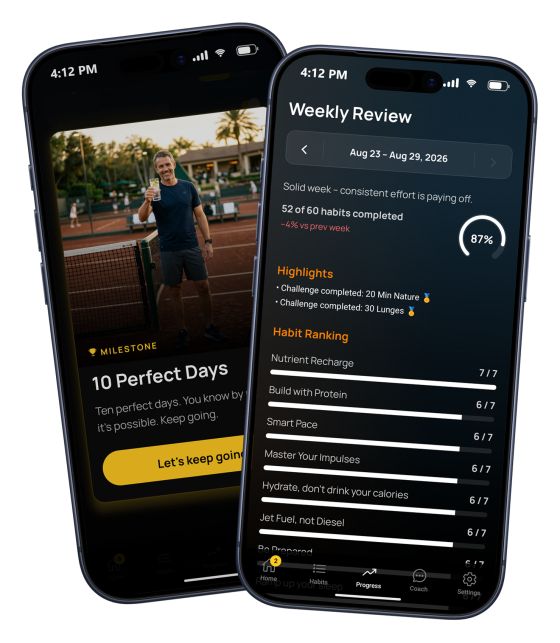
ZANE builds one nutrition habit at a time. No calorie counting, no meal logging. Try it free for 7 days.
Find your first habit