Real-Life Eating
What High Performers Eat: Nutrition for Executives
Men who eat well under a heavy workload rely on a few defaults rather than a perfect plan. Here's what that looks like from breakfast to the second drink.
 Jan B.Co-Founder and CTO of ZANE
- 5 min read
- 7 sources

In this article 8 sections
Key takeaways
- A lunch built on protein and vegetables keeps the afternoon dip smaller than a big, carb-heavy meal.
- Even mild dehydration of about 1.6 percent of body weight impaired attention and mood in men.
- Order first at business lunches and make any drink a deliberate choice.
- Cut liquid calories, mindless snacking and the second drink before anything else.
Under a heavy workload, the most sophisticated nutrition plan usually loses to the most consistent one.
Men who eat well while running a company or a team rarely track meals or tune their macros. They rely on a few default behaviors that run without much thought and still produce a decent result on the worst day of the year. Here’s what that looks like, meal by meal.
Energy and focus come first
Most nutrition advice is about body weight. For men with demanding jobs, the more pressing goal is often a clear head: steady focus, stable energy and no collapse in the last three hours of a twelve-hour day. The habits that support that overlap almost completely with the ones that improve body composition. Only the emphasis changes.
The afternoon dip. Part of it is built into your body clock and shows up even when people skip lunch. A large, carb-heavy lunch can make it worse. A lunch built on protein and vegetables with a moderate portion of carbs is the easiest way to keep the afternoon usable.
Water. Mild dehydration is enough to notice. In a study of young men, losing about 1.6 percent of body weight in fluid impaired attention and working memory and made them feel more tired and tense. Keep a bottle on your desk and have a glass of water before your first coffee. Pale urine is a simple sign you’re drinking enough.
Movement. Exercise supports focus as well as fitness. A meta-analysis found a small but consistent boost in cognitive performance during and after a single bout of exercise. A brisk walk before a demanding meeting is one of the cheapest tools you have. More on this in why walking works for fat loss.
Breakfast that actually happens
For many busy men, breakfast is either nothing or something fast and thin: a coffee, a granola bar, maybe a yogurt. A breakfast that works has three properties. It’s high in protein, low in sugar and ready in minutes.
Protein keeps you full longer than the same calories from carbs or fat. A sugary breakfast often leaves you hungry again by mid-morning. And if it takes longer than five minutes, it won’t happen on the morning with a 7 a.m. call or a 6:30 flight.
Options that meet all three: scrambled eggs with whatever vegetables you have, Greek yogurt with fruit and a little granola, cottage cheese with berries, or a protein shake with oats blended in. Each takes under five minutes and costs less than a coffee-shop order. How much protein men actually need explains why this meal is worth getting right.
The business lunch
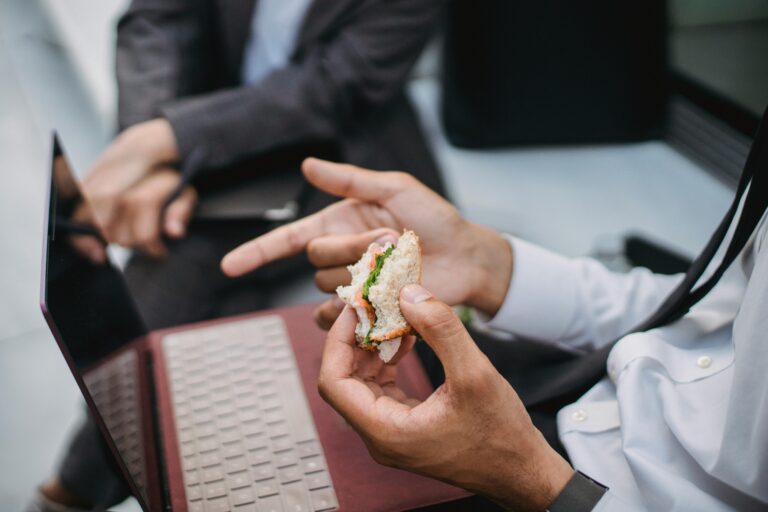
Business lunches are the hardest meal of the week. You don’t control the kitchen, the table sets the mood, and there’s often a drink on offer in the middle of the day.
Order first. If you order last, what everyone else picked shapes your choice. Ordering first lets you set your own default.
Protein and vegetables first. Start with them before the bread and the starters. In a small study of people with type 2 diabetes, eating protein and vegetables before the carbs lowered the rise in blood sugar after the meal considerably compared with the reverse order, even though the meal itself was the same.
Make the drink a decision. Many men notice that even one drink at lunch takes the edge off the afternoon. Sometimes it’s still the right call for the relationship. Just make it a choice rather than a default.
Know your safe categories. Grilled or roasted protein with vegetables, sashimi or simple sushi rolls, and build-your-own bowls all work without studying the menu.
Dinner without the crash
Dinner is the meal most often handled worst, because you get home tired, hungry and with the least self-control of the day.
Stock the kitchen, not the meal plan. With a rotisserie chicken, a bag of salad and frozen vegetables in the fridge, dinner is ready in eight minutes. With nothing usable in the fridge, dinner is delivery. That’s often fine, but you lose control over what arrives.
Protein on the plate first. Build the meal around it and add the rest.
Don’t save your whole day for dinner. Many men eat very little during the day and then eat most of their calories in the evening. Eating properly at breakfast and lunch keeps dinner a normal meal instead of a catch-up session. How to eat healthy when you’re busy has the kitchen list and fallback meals.
What they cut first
Liquid calories. Your body barely registers calories from drinks. In one study, people compensated for extra calories from jelly beans by eating less at meals, but not for the same calories from soda. Sweetened coffee drinks, juice, energy drinks and alcohol are the first things to look at.
Mindless snacking. Planned snacks are fine. The problem is what you grab walking through the kitchen, during a call or while waiting for something. If it isn’t within reach, it doesn’t get eaten, and no willpower is required.
The second drink. One drink at an event is often part of the job. The second is usually just momentum. Alcohol breaks up sleep in the second half of the night, and regular two-drink evenings add up over months. See what alcohol does to your body composition.
Performance over appearance
More men now train and eat for what their body can do: strength, energy, keeping up with their kids, hiking without knee pain, still being able to sprint at 45. That goal holds up better than chasing a look, because it doesn’t depend on a strict cutting phase that ends after twelve weeks.
It also changes the question you ask yourself. Instead of “how do I look?”, ask what the man you want to be would eat, how he would train and which small habit you could start with this week to get closer to him.
The bottom line
High performers don’t need a complicated way of eating. They need a simple one that runs by itself: protein at every meal, balanced lunches that keep the afternoon usable, water as the default drink, a five-minute breakfast and a restaurant default that needs no thought. It takes no tracking and no logging. It just has to be simple enough to survive your worst week, which is why building it one habit at a time works better than switching everything on Monday.
Sources
- Monk TH. The post-lunch dip in performance. Clinics in Sports Medicine, 2005. doi:10.1016/j.csm.2004.12.002
- Ganio MS et al. Mild dehydration impairs cognitive performance and mood of men. British Journal of Nutrition, 2011. doi:10.1017/S0007114511002005
- Chang YK et al. The effects of acute exercise on cognitive performance: a meta-analysis. Brain Research, 2012. doi:10.1016/j.brainres.2012.02.068
- Weigle DS et al. A high-protein diet induces sustained reductions in appetite, ad libitum caloric intake, and body weight despite compensatory changes in diurnal plasma leptin and ghrelin concentrations. American Journal of Clinical Nutrition, 2005. doi:10.1093/ajcn/82.1.41
- Shukla AP et al. Food order has a significant impact on postprandial glucose and insulin levels. Diabetes Care, 2015. doi:10.2337/dc15-0429
- DiMeglio DP, Mattes RD. Liquid versus solid carbohydrate: effects on food intake and body weight. International Journal of Obesity, 2000. doi:10.1038/sj.ijo.0801229
- Ebrahim IO et al. Alcohol and sleep I: effects on normal sleep. Alcoholism: Clinical and Experimental Research, 2013. doi:10.1111/acer.12006
Jan B. is a sports scientist from the German Sport University Cologne and ZANE's CTO. Before building the app, he ran his own personal training studio in Cologne and taught more than 3,000 hours of group classes.
All articles by Jan B. →Your first habit is waiting
ZANE builds one nutrition habit at a time. No calorie counting, no meal logging. Try it free for 7 days.
Find your first habit