Real-Life Eating
Best Nutrition App for Men in 2026
MyFitnessPal, Noom, Cronometer, Levels and ZANE compared for busy men. The best app is the one you'll still be using in month four.
 Jan B.Co-Founder and CTO of ZANE
- 5 min read
- 3 sources
In this article 9 sections
Key takeaways
- Tracking helps when you keep it up, but in a trial of MyFitnessPal most people stopped logging after the first month.
- Logging apps suit men who enjoy precision. Most busy men drop them in the first hard weeks.
- Glucose monitors deliver interesting data, but acting on it still takes habits.
- Pick the app that needs the least daily input for the result you want.
Most nutrition apps are built for the widest possible audience. Their logging screens, community boards and daily check-ins are designed around an average user, not around a man with a packed calendar who needs results that outlast the first month.
Here’s what the major nutrition apps do in 2026, who each one suits and what to look for if you’re a busy man. ZANE is our own app, so weigh that section accordingly. Prices are as of September 2026 and change often, so check before you sign up.
What to look for
“Best app” depends on what you need it to do. For busy men, four questions matter most.
How much daily input does it need? An app that takes 15 minutes of logging a day to stay useful is an app you’ll drop in a hard week.
Does it change behavior or only measure it? Tracking shows you what happened. That can help: in reviews of weight loss studies, people who consistently recorded what they ate lost more weight. The catch is the word consistently. In a randomized trial of MyFitnessPal in primary care patients, most people used the app less and less after the first month, and after six months their weight loss was no different from the group that didn’t get the app.
Is it built for men? Most apps serve a mixed audience, and their content, community and tone reflect that. Men are also underrepresented in weight loss programs generally. In lifestyle weight loss trials, only about 27 percent of participants were men.
Does it hold up in month four? Almost any app works in month one, when motivation is high and everything is new. The real test is whether it still works after the first hard weeks.
MyFitnessPal
The most widely used food tracker, with a huge food database, macro and micronutrient tracking and connections to most fitness wearables. Premium adds barcode and photo scanning, custom macro goals and no ads, and Premium+ adds a meal planner. There’s a free version, and Premium runs about $20 a month or $80 a year.
Who it suits: men who enjoy tracking and find precision motivating, such as bodybuilders, physique competitors and anyone whose meals are already routine and who just wants a logging layer.
Where it struggles: it’s built around logging, and logging needs daily input. Skip a day and the numbers stop meaning much. Skip a week and most people stop opening it.
For busy men: useful for a week or two to see what you actually eat. Hard to keep up as a long-term system.
Noom
A psychology-based weight loss app with short daily lessons, food logging with a color system (green, yellow, orange) and access to coaching. Noom also runs separate programs with GLP-1 medication. The weight program costs about $70 a month on a monthly plan and about $17 a month on a twelve-month plan.
Who it suits: people who like a structured lesson format, find food categories helpful and have the time for daily reading.
Where it struggles: the daily lessons of five to ten minutes can feel like homework after a long workday, and the logging has the same weak spot as any tracker. The best Noom alternative for men goes through it in detail.
For busy men: a good product for the right user. That user usually has more time than a founder or executive.
Cronometer
A precision tracker with a stronger micronutrient database than MyFitnessPal. Popular with health optimizers and people tracking specific targets such as iron, B12 or zinc, often together with a dietitian.
Who it suits: men with a specific medical or nutrient question who need exact intake data.
For busy men: a good diagnostic tool for a defined question. It isn’t designed to build habits.
Levels
A continuous glucose monitor paired with an app that shows how individual foods affect your blood sugar. Pricing depends on the membership tier and the number of sensors, and it’s among the more expensive options.
Who it suits: men who want to see their personal response to specific meals. The data is interesting and can’t be had from a calorie tracker.
Where it struggles: it produces data rather than behavior change. Acting on that data still takes habits.
For busy men: an optimization tool that works best on top of solid habits, not in place of them.
ZANE
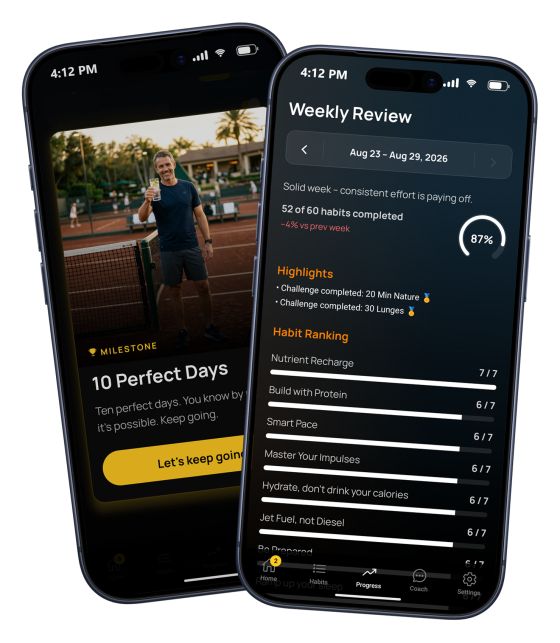
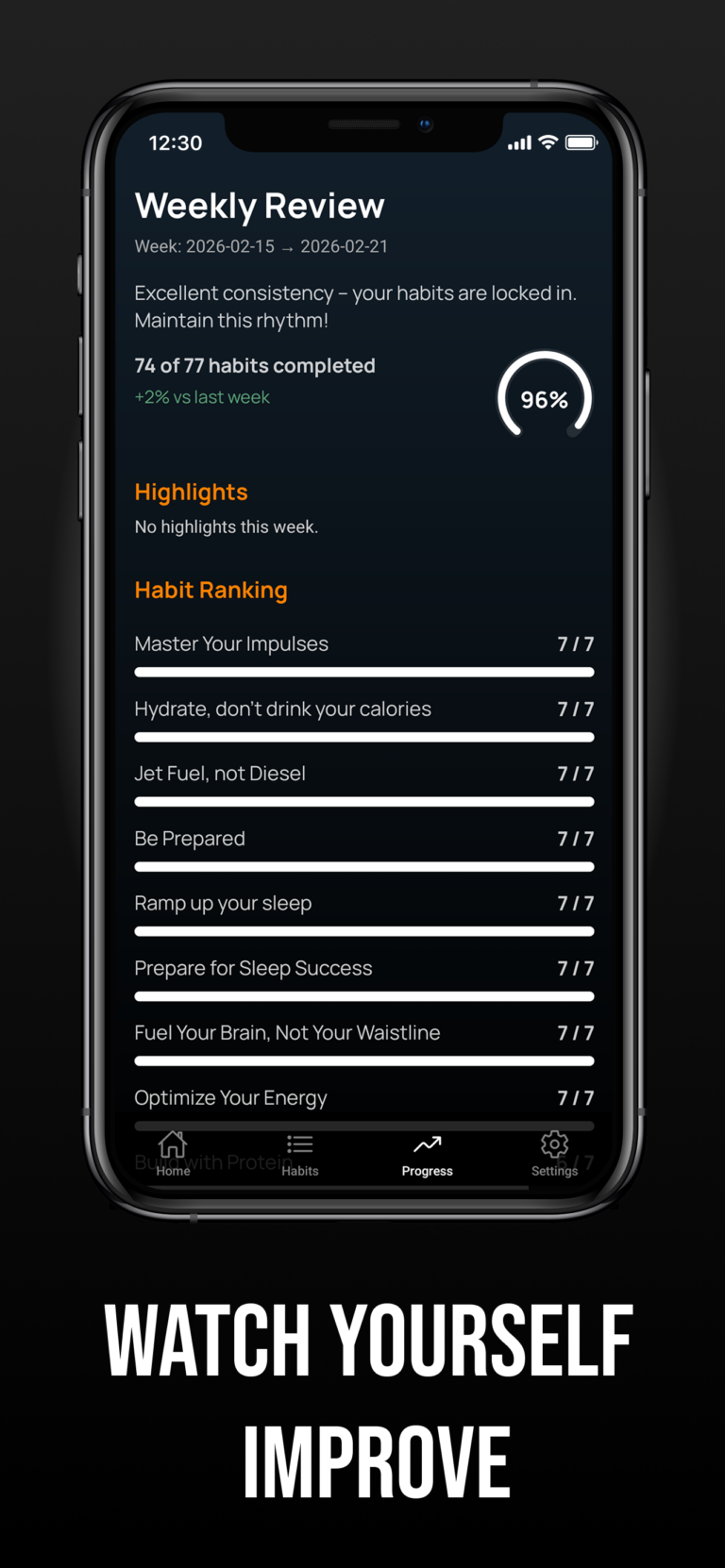
A habit app built only for men. There’s no calorie counting, no meal logging, no meal plan and no daily lessons. Onboarding looks at where you already stand across a set of habits, and the app starts you with one new habit, such as more protein at each meal. Once it’s been running for about a week, the next one unlocks, and the list on your home screen grows. An AI coach answers questions, looks at photos of your meals and gets in touch on its own if you’ve gone quiet for three days. Weight and progress photos are optional.
Who it suits: men who want lasting results and have found tracking apps impossible to keep up, especially with demanding jobs, where food needs to run in the background.
Where it struggles: if you need exact calorie and macro numbers, for competition prep or a clinical reason, you need a tracking app.
Price: 7-day free trial, then $24 a month, or $144 a year on the annual plan.
Tracking assumes a calm week
Tracking works best when meals are predictable, time is plentiful and stress is low. Business travel, client dinners and twelve-hour days break that quickly. Every logged meal adds friction and every estimate adds doubt, so eventually men stop logging or stop looking at the numbers.
A habit-based approach works with guardrails instead of exact data: a few simple rules, clear defaults and fallback meals for bad days. That’s enough structure to guide what you eat without falling apart under pressure. How to lose weight without counting calories shows what those rules look like.
How to choose
The right app is the one you’ll still be using in month four, after the first hard weeks have tested it.
If you enjoy tracking and have kept it up before, any of the logging apps will give you accurate data. If you’ve downloaded trackers and dropped them by month two, more willpower won’t fix that. Look for an approach that doesn’t need daily input to work. Why you can’t stick to a diet explains why the setup matters more than the effort.
Sources
- Burke LE et al. Self-monitoring in weight loss: a systematic review of the literature. Journal of the American Dietetic Association, 2011. doi:10.1016/j.jada.2010.10.008
- Laing BY et al. Effectiveness of a smartphone application for weight loss compared with usual care in overweight primary care patients: a randomized, controlled trial. Annals of Internal Medicine, 2014. doi:10.7326/M13-3005
- Pagoto SL et al. Male inclusion in randomized controlled trials of lifestyle weight loss interventions. Obesity, 2012. doi:10.1038/oby.2011.140
Jan B. is a sports scientist from the German Sport University Cologne and ZANE's CTO. Before building the app, he ran his own personal training studio in Cologne and taught more than 3,000 hours of group classes.
All articles by Jan B. →Your first habit is waiting
ZANE builds one nutrition habit at a time. No calorie counting, no meal logging. Try it free for 7 days.
Find your first habit