Sleep & Stress
How to Stop Stress Eating for Good
Stress makes comfort food more tempting and weakens your brakes at the same time. These five changes make evening stress eating rarer and smaller.
 Jan W.Co-Founder and Head Coach of ZANE
- 5 min read
- 7 sources
In this article 6 sections
Key takeaways
- Stress pushes many people toward sweet and high-fat food and weakens impulse control in the brain.
- Short sleep and skipped meals make evening stress eating more likely.
- In one study, a 15-minute brisk walk roughly halved chocolate snacking during a stressful task.
- Keep trigger foods out of the house and attach a different routine to the stress signal.
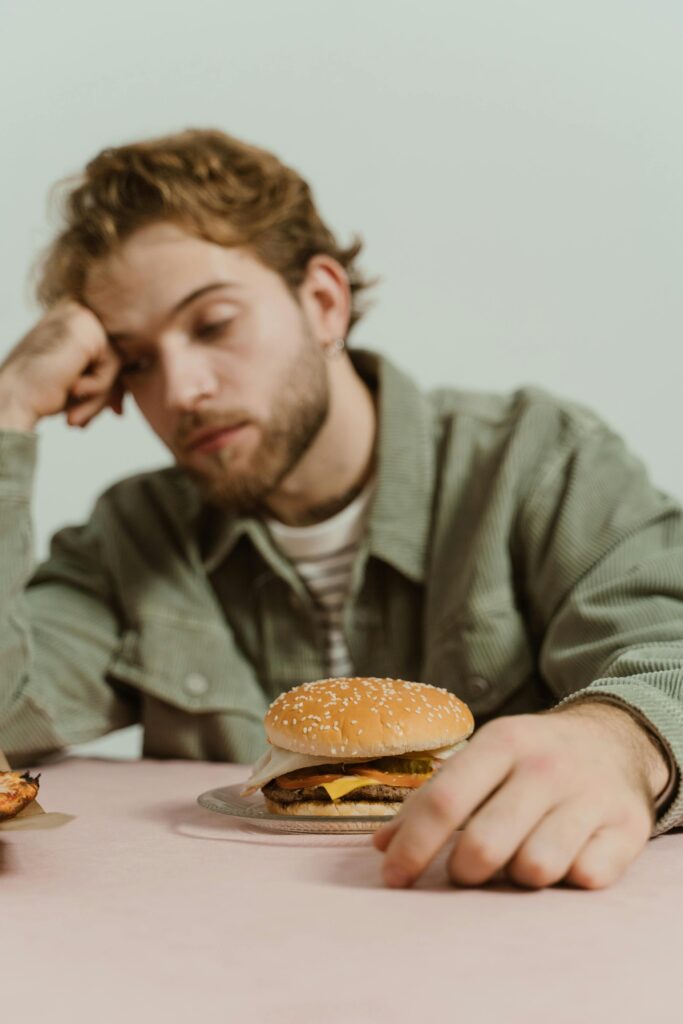
A long day ends, the laptop finally closes, and ten minutes later you’re standing at the pantry eating something you never planned to eat.
Most men file this under a lack of discipline. It’s more useful to treat it as a predictable response to stress, because a predictable response is something you can plan around. Here’s what stress does to appetite, why it gets worse in long, demanding stretches and what actually reduces it.
What stress does to appetite
Stress doesn’t affect everyone the same way. Some people lose their appetite under pressure. Many others eat more, and when they do, they reach for sweet and high-fat foods rather than a bigger portion of dinner. Reviews of the research link this to cortisol and to the brain’s reward system, which responds strongly to energy-dense food.
At the same time, stress weakens the prefrontal cortex, the part of the brain that handles planning and impulse control, and hands more control to automatic, habitual responses. So the pull toward comfort food gets stronger just as your brakes get weaker.
There’s one more reason the habit sticks. Comfort food seems to take the edge off the stress response for a while, at least in animal studies. Eating after a hard day works in the short term, and the brain remembers that.
Why it gets worse in busy stretches
The stress response is built for short threats. Long workdays, constant notifications and little recovery keep it switched on for weeks at a time.
Busy periods usually bring two more problems. Sleep gets shorter, and short sleep raises hunger hormones and makes high-calorie food more tempting on its own. How sleep deprivation makes you fat covers the details. Meals get skipped too. A man who has coffee for breakfast and a light lunch reaches the evening stressed and hungry at the same time.
If you eat well in quiet weeks and fall apart in busy ones, look at what changed around you before you blame yourself.
What doesn’t help
Relying on willpower in the moment. At 10 p.m. after a brutal day, the part of your brain that willpower depends on is the part stress has already weakened. You can still say no sometimes, but a plan that depends on it every evening will fail in the weeks you need it most.
Guilt afterwards. Feeling bad about last night doesn’t prevent tonight, and for many people it adds to the stress that started the cycle.
Banning foods completely. In research on dieting, rigid all-or-nothing rules were linked to more episodes of overeating, while flexible control, where no food is off limits but amounts are limited, was linked to a lower body weight. A total ban makes the one slip feel like the end of the diet.
What works
Lower the load that feeds it. Sleep is the first lever, because short nights make everything above worse. Movement is the second. In a workplace simulation, regular chocolate eaters who took a 15-minute brisk walk before a stressful computer task ate about half as much of the chocolate on their desk as those who sat. You don’t need an hour in the gym to get that effect. A walk at lunch or after work is enough to start with.
Change what’s in the house. Habits respond to their surroundings more than to taste. In one study, people who usually ate popcorn at the movies ate about as much stale, week-old popcorn as fresh popcorn when they were in a cinema. The setting drove the eating. The same applies to your kitchen. If chips, cookies and ice cream are there, that’s what gets eaten on a bad evening. If they aren’t, the bad evening passes with something else. You can’t count on discipline at 10 p.m., but you can make a different decision at the store three days earlier. Stock the house for your worst day, not your best.
Give the stress signal a different response. Stress eating runs like any habit. There’s a cue (the tense, drained feeling after a hard stretch), a routine (eating) and a reward (a few minutes of relief). To change the routine, attach something else to the same cue: a walk around the block, ten push-ups, a glass of water, two minutes of slow breathing, a few minutes outside. None of these solves the stress. They create a pause long enough for you to decide instead of acting on autopilot. It also helps to notice the lines that usually come with the habit, such as “I earned this” or “this is just what I do when I’m stressed.” Once you can hear them, they lose some of their pull. More on how this works in how habits actually work.
Eat enough during the day. Much of what looks like stress eating is plain hunger that built up since the morning. A real breakfast and lunch with a good portion of protein take that part away, and what’s left in the evening is easier to handle. See how much protein men actually need.
Put the screen away when you eat. A meta-analysis of studies on attention and eating found that people who ate while distracted ate more at that meal and more later in the day. Eating with your attention on the food made later snacking smaller. Before you eat in the evening, check if it’s hunger or tension. Then, if you eat, sit down, put the phone away and pay attention to it.
The bottom line
Stress eating shrinks when you change the conditions around it: more sleep, some daily movement, a kitchen stocked for a bad day, a planned response to the stress signal and enough food before the evening. None of it takes exceptional discipline. Aim for fewer and smaller episodes rather than a perfect record, with a setup that holds in busy weeks too. Eating habits that stick shows how to build that setup step by step.
Sources
- Torres SJ, Nowson CA. Relationship between stress, eating behavior, and obesity. Nutrition, 2007. doi:10.1016/j.nut.2007.08.008
- Adam TC, Epel ES. Stress, eating and the reward system. Physiology & Behavior, 2007. doi:10.1016/j.physbeh.2007.04.011
- Arnsten AFT. Stress signalling pathways that impair prefrontal cortex structure and function. Nature Reviews Neuroscience, 2009. doi:10.1038/nrn2648
- Westenhoefer J et al. Validation of the flexible and rigid control dimensions of dietary restraint. International Journal of Eating Disorders, 1999. doi:10.1002/(SICI)1098-108X(199907)26:1<53::AID-EAT7>3.0.CO;2-N
- Oh H, Taylor AH. Brisk walking reduces ad libitum snacking in regular chocolate eaters during a workplace simulation. Appetite, 2012. doi:10.1016/j.appet.2011.11.006
- Neal DT et al. The pull of the past: when do habits persist despite conflict with motives? Personality and Social Psychology Bulletin, 2011. doi:10.1177/0146167211419863
- Robinson E et al. Eating attentively: a systematic review and meta-analysis of the effect of food intake memory and awareness on eating. American Journal of Clinical Nutrition, 2013. doi:10.3945/ajcn.112.045245
Jan W. is a sports scientist from the German Sport University Cologne and has coached for 20 years, from busy professionals to pro athletes. He has lived on Hawaii for over a decade and has the final word on everything training-related at ZANE.
All articles by Jan W. →Your first habit is waiting
ZANE builds one nutrition habit at a time. No calorie counting, no meal logging. Try it free for 7 days.
Find your first habit